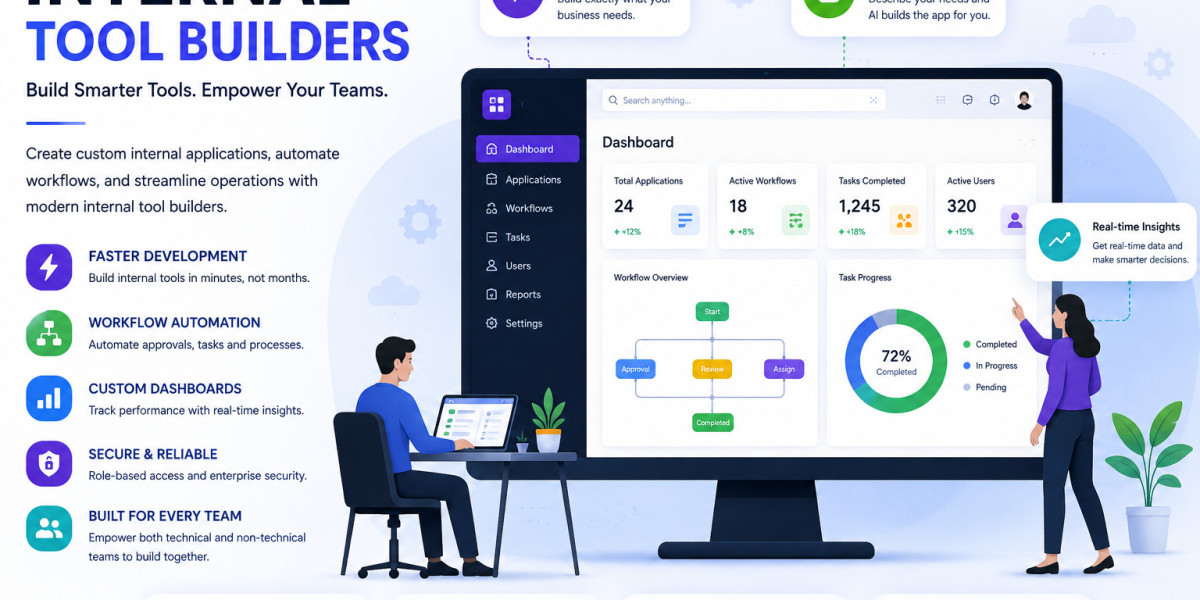

Businesses rely on digital tools to manage their daily operations, organize information, automate repetitive tasks, and improve collaboration between teams. While traditional software development can provide powerful solutions, building every internal application from scratch can require considerable time, technical expertise, and resources. This is where Internal Tool Builders can provide a practical alternative.
Internal tool builders help organizations create customized applications for their specific business processes. These tools can include dashboards, approval systems, inventory trackers, employee management applications, customer request portals, reporting systems, and workflow automation solutions. With the growing use of artificial intelligence, modern platforms are making the process of creating internal tools even faster and more accessible.
What Are Internal Tool Builders?
Internal tool builders are software development platforms designed to help businesses create applications used within their organizations. Unlike consumer-facing applications, internal tools are generally created to support employees, departments, managers, and operational teams.
For example, a company may need an application for managing employee requests. Instead of developing a complete system manually, the organization can use an internal tool builder to create forms, approval processes, notifications, dashboards, and data management features.
These platforms can reduce the amount of traditional coding required while allowing organizations to build tools according to their specific requirements.
Why Businesses Need Internal Tools
Every business has unique processes. A retail company may need inventory management tools, while a service company may require customer request management software. A manufacturing organization might need production tracking and employee scheduling applications.
Generic software does not always provide the exact features a business needs. Custom development can solve this problem, but it may require a large development budget and significant time.
Internal tools provide a middle ground. Businesses can create applications specifically for their workflows without necessarily developing everything from the ground up.
Well-designed internal tools can help employees:
Manage information more efficiently
Automate repetitive processes
Track business activities
Submit and approve requests
Monitor important metrics
Collaborate across departments
Reduce manual data entry
Improve operational visibility
The Rise of AI-Powered Internal Tool Development
Artificial intelligence is changing the way applications are created. Traditional development usually begins with detailed requirements, wireframes, database design, coding, testing, and deployment.
AI-powered development platforms can simplify parts of this process. Users can describe what they want to build using natural language, and AI can help generate an initial application structure.
For example, a business user could explain that they need a leave management application where employees submit requests, managers approve them, and HR can view reports. An AI-assisted tool builder can use these requirements to create a starting point for the application.
The generated application can then be reviewed and customized to match the organization's actual processes.
Natural-Language Application Creation
One of the most useful features of modern internal development platforms is natural-language interaction.
Instead of explaining every requirement through technical documentation, users can describe their desired application in ordinary language. AI can interpret those requirements and assist with creating relevant components.
This can improve communication between business teams and developers. Employees who understand the business process but have limited programming knowledge can participate more actively in application creation.
Natural-language development does not eliminate the need for human review. Businesses should still verify workflows, permissions, data structures, and business rules before deploying an application.
Workflow Automation
Many internal business processes involve repetitive steps. A request may need to be submitted, reviewed, approved, assigned, completed, and documented.
Internal tool builders can help organizations turn these processes into automated workflows.
For example, an expense approval workflow could include:
An employee submits an expense request.
The request is sent to a manager.
The manager reviews the information.
Approved requests move to the finance team.
Finance completes the final processing.
The system records the completed transaction.
Automating these steps can reduce manual work and make processes more consistent.
Building Custom Dashboards
Business leaders and managers often need quick access to operational information. Internal applications can provide dashboards that display important metrics in an easy-to-understand format.
A sales dashboard might show orders, revenue, leads, and customer activity. An operations dashboard could display pending tasks, completed requests, inventory levels, or production information.
Internal tool builders can help teams create these dashboards without developing every interface manually.
Custom dashboards also allow organizations to focus on the information that matters most to their particular business.
Employee Management Tools
Human resources departments frequently rely on internal applications for employee-related processes.
Examples include:
Employee onboarding
Leave requests
Attendance management
Performance tracking
Training records
Equipment requests
Employee documentation
Instead of managing these processes through spreadsheets, emails, and disconnected systems, businesses can create centralized internal applications.
A centralized tool can make information easier to access while providing employees and managers with a more organized workflow.
Inventory and Operations Management
Inventory management is another area where internal tools can provide significant value. Businesses need to know what products or materials are available, what has been used, and what needs to be reordered.
An internal inventory application can track stock levels, incoming items, outgoing items, suppliers, and related information.
The same approach can be applied to other operational processes, including equipment tracking, maintenance requests, procurement, and task management.
Benefits for Development Teams
Internal tool builders are not only useful for non-technical employees. Developers can also benefit from these platforms.
Development teams often receive requests for relatively small internal applications. Although these projects may be important, they can compete for resources with larger software initiatives.
An internal tool builder can provide developers with reusable components and AI-assisted features that speed up development.
This allows developers to focus more on complex requirements, integrations, security, architecture, and other high-value technical tasks.
Benefits for Business Teams
Business teams often understand their processes better than anyone else. However, they may not have the programming knowledge required to build software traditionally.
Internal tool builders can give these teams a more direct role in application development.
With visual interfaces and AI assistance, employees can help define requirements, review generated applications, modify workflows, and provide feedback.
This collaboration can reduce the gap between business requirements and technical implementation.
Visual Workflow Design
Visual workflow design is an important feature of many modern internal application platforms.
Instead of representing every process through complex programming code, visual builders can display workflows through connected steps and actions.
Users can see how information moves through a process and identify where approvals, conditions, notifications, or assignments occur.
This can make workflows easier to understand and modify, particularly for teams that are familiar with business operations but not with programming languages.
Security and Access Control
Security should be a major consideration when developing internal business applications.
Internal tools may contain employee information, financial records, customer data, operational details, or other sensitive business information. Organizations therefore need appropriate authentication and access controls.
Different users may require different permissions. For example, an employee might only be able to submit requests, while a manager could review requests and an administrator could manage the entire workflow.
Businesses should evaluate the security features, authentication methods, authorization controls, deployment architecture, and data handling practices of any internal development platform before using it for important business processes.
Scalability and Flexibility
A successful internal application should be able to adapt as the business grows.
A small company may initially require only a basic employee request system. As the organization expands, it may need additional departments, approval levels, reports, integrations, and user roles.
Flexible internal tools can evolve alongside these changing requirements.
Scalability is particularly important for organizations that expect their number of users, workflows, or data records to increase over time.
Integrating Existing Business Systems
Most businesses already use multiple software systems. An internal application may need to communicate with databases, customer relationship management systems, accounting software, communication platforms, or other services.
Integration capabilities can therefore be an important part of internal tool development.
Connecting different systems can reduce duplicate data entry and create a more connected operational environment. For example, an internal application could retrieve information from an existing database and display it in a custom dashboard.
Businesses should evaluate available APIs, database connections, authentication options, and integration capabilities when selecting a platform.
Reducing Development Time
One of the main reasons businesses explore internal tool builders is the potential to reduce the time required to create applications.
Traditional development can involve multiple stages, including planning, design, coding, testing, deployment, and maintenance. AI assistance, reusable components, and visual builders can accelerate some of these activities.
Faster development can be particularly valuable when a business needs a solution quickly to address an operational problem.
However, speed should not come at the expense of quality. Applications should still be tested carefully before being introduced into important business workflows.
Internal Tools and Business Productivity
The ultimate goal of internal applications is to make employees more productive.
When workers spend less time searching through spreadsheets, sending repetitive emails, manually entering information, or following complicated approval processes, they can focus more on valuable tasks.
A well-designed internal tool can centralize information and make routine processes easier to complete.
For example, instead of communicating a request through multiple emails, an employee can submit it through a dedicated application where the request status can be tracked from submission to completion.
How to Choose the Right Internal Tool Builder
Businesses should consider several factors before selecting an internal application development platform.
Ease of Use
The platform should provide an interface that is understandable to both technical and business users.
AI Capabilities
Organizations should evaluate how effectively AI can assist with application generation, workflows, business logic, and other development tasks.
Customization
Businesses need the ability to modify applications according to their unique processes.
Security
Authentication, permissions, data protection, and deployment options should be reviewed carefully.
Integration
The platform should support the systems and services that the organization already uses.
Scalability
The solution should be capable of supporting future growth and increasing application complexity.
Maintenance
Organizations should consider how easily applications can be updated when business processes change.
The Future of Internal Tool Development
The future of internal application development is likely to involve greater collaboration between artificial intelligence and human developers.
AI can assist with repetitive development tasks, application generation, documentation, testing, and workflow creation. Developers and business users can then focus on reviewing results and improving applications according to real-world requirements.
As AI technology continues to develop, creating specialized internal applications may become faster and more accessible.
This could allow smaller organizations to build useful business tools without maintaining large software development teams for every project.
Conclusion
Internal Tool Builders provide businesses with a flexible approach to creating applications for their unique operational needs. From employee management and inventory tracking to approval workflows and business dashboards, internal tools can help organizations improve productivity and streamline everyday processes.
The combination of artificial intelligence, natural-language application creation, visual workflow design, automation, and integration capabilities is making internal application development more accessible.
For businesses that need customized software but want to avoid the time and complexity of building every application entirely from scratch, internal tool builders can be a practical solution. With careful attention to security, scalability, customization, and business requirements, organizations can use these platforms to create tools that support their teams and improve their operations.