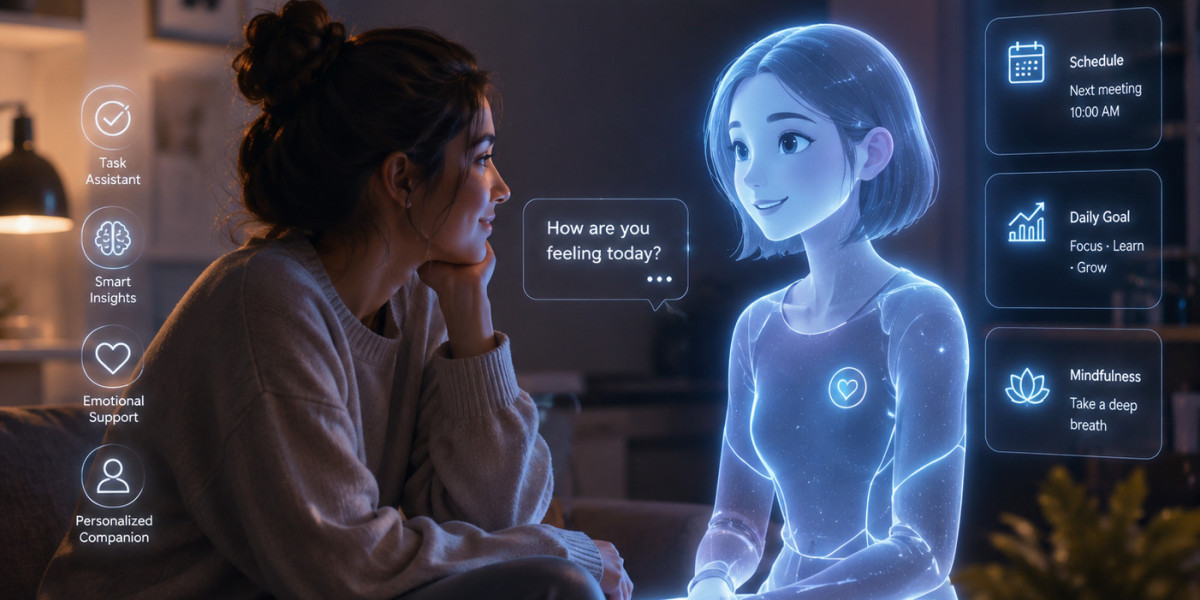

AI companion apps are moving beyond simple question-and-answer conversations. The newer generation of these apps is designed to remember preferences, adapt conversation styles, recognize recurring interests, and create a sense of continuity across interactions. Instead of treating every chat as a separate session, personalization allows an AI companion to build a more consistent conversational experience over time.
This shift is happening as users spend more time interacting with conversational AI. Data from Appfigures reported that dedicated AI companion apps had reached 220 million downloads globally across the App Store and Google Play as of July 2025. Downloads during the first half of 2025 reached 60 million, representing an 88% year-over-year increase.
Personalization Is Changing the AI Companion Experience
The growing interest in AI girlfriend apps shows how much users value conversations that feel tailored rather than generic. A companion that remembers a preferred conversation style, favorite topics, recurring interests, or previous discussions can create a much stronger sense of continuity.
This matters because users generally do not want to repeat the same information every time they open an application. If a person has already explained their interests, preferred tone, hobbies, or communication preferences, repeating those details can make the experience feel mechanical.
Personalization addresses this problem through persistent user profiles and conversational memory. A system can store selected information and use it when generating future responses.
For example, a user may prefer:
Short and direct responses
Humorous conversations
Motivational discussions
Casual language
Specific hobbies or interests
Voice conversations rather than text
A particular personality style
The companion can gradually adjust its responses around these preferences.
Research from the Imagining the Digital Future Center found that 43% of AI companion users surveyed agreed that AI understands them as a person. Another 39% agreed that AI understands them better than most people. The same research found that 47% of AI companion users regularly use two or more different bots or personalities.
These numbers suggest that personalization is not merely a technical addition. It is closely connected to how users evaluate their relationship with conversational AI.
Memory Makes Conversations Feel Continuous
Memory is arguably one of the most important components of personalized AI companions.
Traditional chatbots often treat each interaction as an isolated exchange. Modern companion systems can maintain selected information across sessions, allowing conversations to continue naturally.
Consider a simple example.
A user talks about learning guitar on Monday. On Wednesday, the user starts another conversation. A personalized companion might remember that guitar is an ongoing interest and ask about recent practice or recommend a related activity.
That small detail can make the interaction feel more coherent.
However, useful memory needs careful design. Storing every conversation permanently would create unnecessary complexity and raise privacy concerns. A better approach is selective memory, where the system identifies information that has genuine long-term value.
A memory architecture can separate information into categories:
Short-term context
Information needed for the current conversation.
Long-term preferences
Stable interests, communication preferences, and recurring topics.
Behavioral patterns
Common interaction times, preferred response length, or frequently selected activities.
User-controlled memory
Information that users deliberately ask the system to remember or delete.
This structure gives personalization a practical foundation without turning the system into an uncontrolled database of every conversation.
Personality Can Adapt Without Losing Consistency
A personalized companion should not feel completely different from one conversation to another.
Consistency matters because personality is part of the product experience. If a companion suddenly changes its communication style, humor, vocabulary, or emotional tone, users may feel that something has been lost.
Modern AI systems can solve this through personality profiles.
A personality profile can define:
Communication style
Emotional tone
Vocabulary preferences
Conversation boundaries
Interests
Humor preferences
Response length
Voice characteristics
Preferred interaction patterns
The AI model then uses this profile alongside the current conversation context.
This does not mean every response needs to follow a rigid script. Instead, the personality acts as a behavioral framework.
For instance, a user who prefers concise conversations might receive shorter responses, while another user who enjoys long discussions might receive more detailed replies.
The personalization layer therefore sits between the basic AI model and the final user experience.
Personalization Is Becoming Multimodal
Text is still central to companion applications, but personalization is moving into voice, avatars, images, and other interaction formats.
A user might prefer a particular voice, speaking speed, avatar appearance, or conversational mood. These choices can become part of the user profile.
Voice personalization is particularly interesting because speech carries characteristics that text cannot fully reproduce. Tone, pacing, pauses, and emotional expression can make an interaction feel considerably different.
Similarly, visual personalization can influence how users perceive a digital character.
A companion may have:
Different avatar appearances
Custom outfits
Multiple expressions
Animated reactions
Personalized environments
Different voice options
The result is a more unified experience where personality is not limited to written responses.
Market research also points toward growing demand for multimodal AI companions. Grand View Research estimates that text-based companions represented 42.7% of the AI companion market revenue share in 2025, while voice and multimodal experiences continue to gain attention as the category expands.
Different Forms of Companionship Need Different Experiences
Not every AI companion should be designed around the same personality model.
Some users want friendship and casual conversation. Others prefer coaching, emotional support, entertainment, roleplay, or relationship-oriented experiences.
This is creating greater variety across the AI companion category. Research examining 110 AI companion platforms found that products are increasingly tailored toward different forms of companionship, including care, support, romantic interaction, and other relationship-oriented experiences. The research estimated global monthly visits across AI companion platforms at between 1.1 billion and 2.2 billion.
This variety means personalization needs to account for user intent.
A coaching-oriented companion might prioritize goals and progress. A creative companion could focus on storytelling and imagination. A social companion might prioritize casual conversation and shared interests.
The underlying AI technology can be similar, but the personalization layer changes the experience considerably.
Relationship Preferences Can Become More Specific
As companion products mature, personalization is also becoming more specific around relationship dynamics and interaction preferences.
This is particularly visible in adult-oriented AI experiences, where users may seek different character personalities, interaction styles, and roleplay scenarios. Search behavior around AI femdom websites is one example of a highly specific preference category that can influence how companion platforms organize characters and experiences.
For developers, the larger lesson is that personalization should not rely on a single generic profile.
Users may want to customize:
Character personality
Interaction style
Relationship type
Conversation intensity
Topics
Voice
Appearance
Roleplay preferences
A flexible profile system can support these choices without forcing every user into the same experience.
Personalization Needs Privacy Controls
The more an AI companion remembers, the more important privacy becomes.
A personalized system can potentially hold sensitive information about conversations, preferences, relationships, routines, and personal experiences. Therefore, users should have clear control over what is stored.
Good personalization design should provide:
Memory visibility
Users should know what the system remembers.
Memory deletion
Users should be able to remove individual memories.
Profile editing
Users should be able to correct outdated information.
Data controls
The product should clearly explain how personal information is processed.
Consent mechanisms
Sensitive personalization should not happen without appropriate user awareness.
This is especially important because personalization can increase trust while also increasing the amount of information users are willing to share.
Research from the Imagining the Digital Future Center found that 39% of AI companion users occasionally tell AI things they would not tell other people. At the same time, only 36% strongly or somewhat agreed that AI cares about their well-being.
That gap is important. A companion may feel personal without actually possessing human emotions. Product design should therefore make the distinction clear while still delivering a useful experience.
Why the Next Generation Will Feel More Individual
The next stage of AI companion development is likely to focus less on simply producing intelligent answers and more on creating consistent individual experiences.
A useful companion should know when to remember something, when not to remember it, when to change its tone, and when to let the user take control.
That creates a significant difference between personalization and customization.
Customization happens when a user selects a setting.
Personalization happens when the product uses those choices, previous interactions, and ongoing preferences to make future interactions more relevant.
For example, a user might select a calm personality during onboarding. Later, the system can recognize that the user usually prefers shorter conversations in the morning and longer discussions at night. These signals can shape the experience without requiring the user to manually adjust settings every time.
That is where AI companion products can become genuinely adaptive.
AI Girlfriend Wiki Can Help Users Compare Companion Experiences
As the category grows, users also need better ways to compare different AI companion experiences before choosing an app. AI girlfriend wiki can serve as a reference point for people researching character-based AI platforms, personalities, features, and available experiences.
A directory or information resource can make a fragmented category easier to navigate. Instead of relying only on app-store descriptions, users can compare different options according to personality, interaction style, customization, voice capabilities, and other characteristics.
For developers and product teams, this also highlights the importance of communicating personalization features clearly. If users cannot see how a companion differs from another product, advanced personalization technology may not translate into stronger adoption.
AI Girlfriend Wiki and the Growing Need for Better Product Discovery
The expansion of companion applications has created a crowded market. Appfigures reported 337 active, revenue-generating AI companion apps worldwide in 2025, with 128 of them released during the first part of that year.
With hundreds of products competing for attention, product discovery becomes increasingly important.
AI girlfriend wiki can fit into this wider discovery process through structured information about different AI companion experiences. This type of resource can help users compare options based on practical criteria rather than choosing solely from advertising messages.
For AI companion developers, the same trend creates pressure to make personalization meaningful rather than treating it as a marketing label.
Personalization Will Become a Core Product Capability
AI companion applications are gradually moving toward experiences that remember, adapt, and respond differently to each individual.
The strongest products will not necessarily be the ones with the largest number of settings. Instead, they will be the ones that make personalization feel natural.
That means remembering useful information without becoming intrusive, adapting communication without losing personality, and giving users control over their data.
AI girlfriend wiki can also play a useful part in this growing ecosystem as users look for information about different companion platforms and their personalization options.
The broader market signals are already strong. Dedicated AI companion apps recorded substantial download growth during 2025, while research indicates that many users value AI systems that feel adaptive and personally relevant.
Conclusion
AI companion apps are becoming more personalized because users increasingly expect digital interactions to remember context, respect preferences, and adapt over time. Memory, personality profiles, voice, avatars, user-controlled settings, and behavioral signals are gradually becoming connected parts of one experience.
The next stage will likely focus on making these systems more subtle and useful. A companion should not require users to configure every detail manually. Instead, it should learn appropriate preferences while giving users clear control over what is remembered.