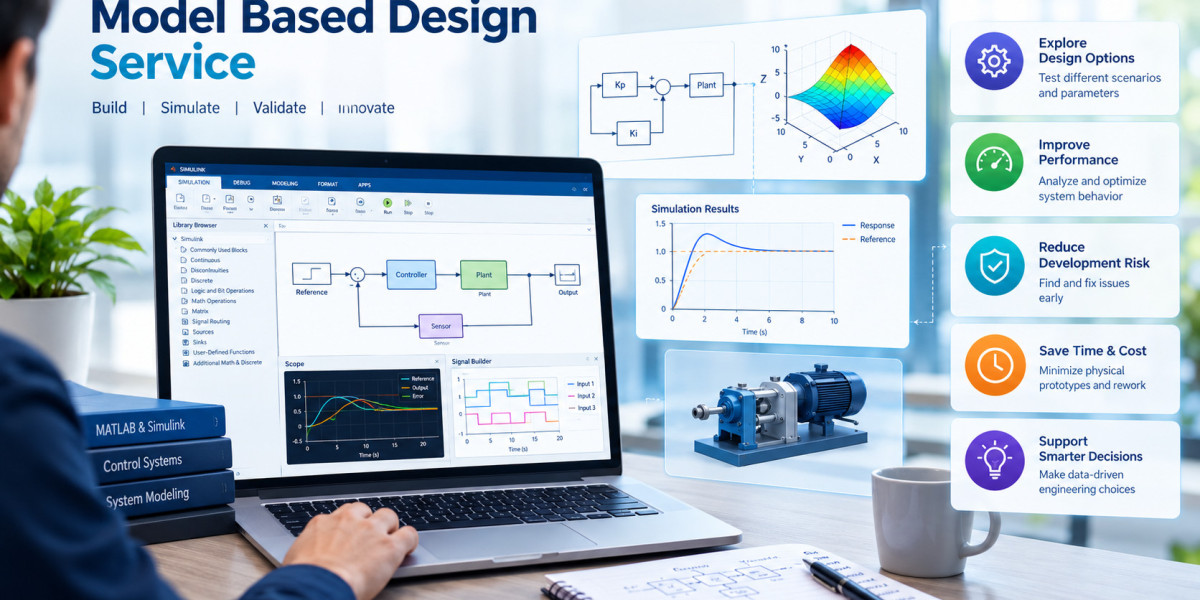

Model-based design allows engineers to use system models to explore design behavior and evaluate control strategies before moving to implementation.
MATLAB Simulink provides a graphical environment for modeling and simulating dynamic systems.
What Is Model-Based Design?
Model-based design is an engineering approach in which models support system development, analysis, and verification.
Engineers represent the behavior of a system using mathematical relationships, functional blocks, and defined connections.
These models can help teams investigate how a system responds to different inputs, operating conditions, and control strategies.
For example, a model of a motor-control system can be used to explore how the system responds to changes in speed commands or operating loads.
The Role of Simulink in System Development
Simulink enables engineers to build block-based representations of dynamic systems and simulate their behavior over time.
Depending on the available software tools and configuration, engineers can model control algorithms, examine signal flows, perform simulations, and support testing activities.
Model-based workflows may also support code generation for compatible target environments, subject to appropriate configuration and verification.
These capabilities are useful when engineers need to evaluate system behavior before implementing a design on physical hardware.
Why Engineers Use Simulation
Simulation allows teams to investigate potential problems earlier in development.
Engineers can compare design alternatives, adjust model parameters, and test different operating conditions without immediately changing physical equipment.
Models can also improve communication between disciplines by providing a shared representation of system behavior.
However, the usefulness of simulation depends on the model's accuracy and assumptions. Results should be verified, and hardware testing remains important when moving toward real-world deployment.
Best Practices for Model-Based Projects
A project should begin with clearly defined requirements and measurable performance targets.
Models should be organized into logical components, documented, and tested against expected behavior.
Engineers should also consider numerical limitations, execution timing, target hardware, and integration requirements when moving from simulation toward implementation.
Servotech Inc. supports engineering-related development activities. Organizations exploring model based design Simulink workflows should identify their modeling objectives and verification needs before choosing the appropriate approach.
Final Thoughts
Model-based design with Simulink provides engineers with tools for evaluating system behavior, developing control algorithms, and investigating design alternatives. A structured modeling and verification process can support better-informed engineering decisions throughout development.