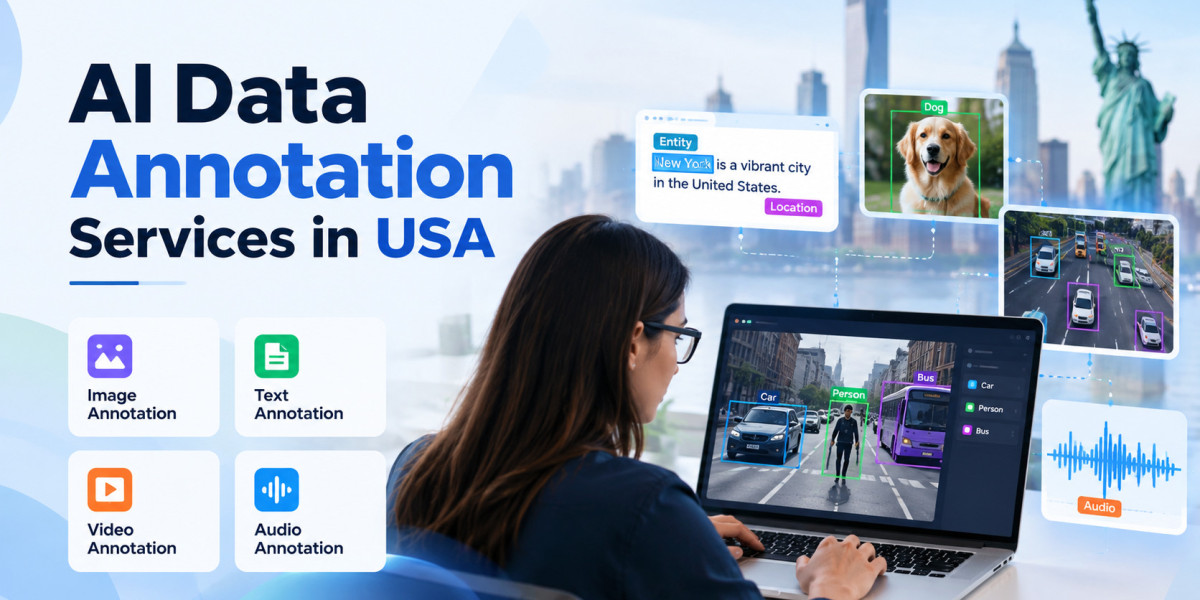

Artificial intelligence is only as reliable as the data used to train it. Whether a company is developing a computer vision system, an AI chatbot, a recommendation engine, or an autonomous application, the training data must be accurate, consistent, and properly organized. This is why businesses increasingly turn to AI Data Annotation Services in USA to prepare high-quality datasets for AI and machine learning projects.
Raw data usually does not tell an AI model what it needs to learn. Images, videos, text, audio files, and documents need to be labeled and structured so machine learning algorithms can identify the right patterns. A poorly labeled dataset can create confusion, reduce model accuracy, and lead to unreliable results.
Professional AI Data Annotation Services help businesses transform raw data into useful training datasets. Instead of relying entirely on internal teams to handle time-consuming annotation work, companies can work with experienced specialists who understand different annotation techniques, quality requirements, and project workflows.
For businesses investing in AI, the goal is not simply to collect more data. It is to create better training data that helps models perform consistently in real-world situations.
What Is AI Data Annotation?
AI data annotation is the process of adding meaningful labels, tags, classifications, or other information to raw data so that an AI or machine learning model can understand it.
For example, consider a company developing an AI-powered system for detecting objects in road images. Thousands of images may contain cars, pedestrians, traffic signs, bicycles, buildings, and roads. Before those images can effectively train a computer vision model, relevant objects need to be identified and labeled.
The same principle applies to other types of data.
Common Types of Data Annotation
Depending on the AI application, annotation may involve:
- Image annotation: Bounding boxes, polygons, segmentation, key points, and image classification.
- Video annotation: Object tracking, activity recognition, and frame-by-frame labeling.
- Text annotation: Sentiment analysis, entity recognition, intent classification, and text categorization.
- Audio annotation: Speech transcription, speaker identification, sound classification, and language tagging.
- Document annotation: Identifying fields, tables, entities, and other useful information in documents.
The objective is to create structured data that gives machine learning algorithms clear examples from which they can learn.
Why Do Businesses Need AI Data Annotation Services in USA?
Developing an AI model involves much more than selecting an algorithm. Businesses need suitable data, reliable annotation processes, quality checks, and continuous improvements.
This is where AI Data Annotation Services in USA can become valuable. They allow organizations to access specialized annotation support without putting the entire workload on their internal AI or data science teams.
1. Better Quality Training Data
Training data directly affects how a machine learning model learns. If the labels are inconsistent or incorrect, the model may learn the wrong patterns.
For example, imagine a retail company training an AI system to identify damaged products from warehouse images. If some damaged items are labeled as acceptable products, the model receives conflicting information during training.
Professional annotation workflows can include annotation guidelines, multiple review stages, validation procedures, and quality monitoring. These practices help reduce labeling errors and improve dataset consistency.
This is one of the main reasons businesses choose AI Data Annotation Services in USA when developing applications where data quality matters.
2. Saves Internal Time and Resources
Data annotation can be extremely time-consuming, especially when a project involves hundreds of thousands or millions of data points.
An internal AI team may need to focus on model development, testing, deployment, monitoring, and optimization. Asking the same team to manually annotate large datasets can slow down the overall project.
By outsourcing annotation work, businesses can distribute responsibilities more effectively. Their technical teams can concentrate on AI development while annotation specialists handle the preparation of training datasets.
This does not eliminate the need for internal oversight. Instead, it creates a more practical division of responsibilities.
3. Supports Large AI Projects
Small AI experiments may require only a limited dataset. Production-level AI systems often require significantly more data.
A healthcare organization developing medical image analysis, for instance, may need large numbers of carefully annotated images. Similarly, an autonomous technology company may require extensive video and image datasets covering different road conditions, objects, environments, and situations.
AI Data Annotation Services in USA can support projects that need structured annotation at scale while following predefined labeling guidelines.
The exact requirements will depend on the project, data type, annotation method, and desired model performance.
How Annotation Quality Affects AI Model Accuracy
It is important to understand that annotation does not automatically make an AI model accurate. Model architecture, data volume, data diversity, training methods, testing, and deployment conditions all matter.
However, high-quality annotation provides a stronger foundation for supervised machine learning.
Suppose an AI model is being trained to identify customer sentiment. If positive, negative, and neutral comments are inconsistently labeled, the model may struggle to understand the differences between them.
Now consider a properly labeled dataset where similar examples are consistently categorized. The model receives clearer training signals and has a better foundation for learning.
This is why AI Data Annotation Services in USA are often considered an important part of the AI development lifecycle rather than simply a data entry task.
What Industries Use AI Data Annotation?
AI annotation is used across many industries because organizations in different sectors are adopting machine learning applications.
Healthcare
Healthcare organizations can use annotated medical images and clinical text for AI research and machine learning applications. Depending on the project, annotation may involve identifying regions in medical images, categorizing documents, or structuring clinical information.
Because healthcare data can be highly sensitive, organizations must also consider privacy, security, regulatory requirements, and access controls when designing annotation workflows.
Retail and E-commerce
Retail businesses can use annotated product images, customer reviews, and transaction-related data for recommendation systems, visual search, product classification, and customer experience applications.
For example, product images can be labeled according to categories, attributes, or specific visual characteristics.
Automotive
Computer vision plays an important role in modern automotive technology. Training datasets may include road images and videos containing vehicles, pedestrians, traffic signals, lane markings, and other objects.
Accurate annotation helps developers create datasets that represent different environments and driving conditions.
Financial Services
Financial organizations can use text and document annotation for applications such as document processing, customer support, fraud-related analysis, and information extraction.
Documents can be annotated to identify relevant fields, entities, categories, or relationships.
Manufacturing
Manufacturers can use image annotation to support AI-powered quality inspection. Products captured by cameras can be labeled according to defects, components, or quality categories.
This can help create datasets for computer vision systems designed to identify manufacturing issues.
How Professional AI Data Annotation Works
A reliable annotation project normally begins with understanding the AI application's objectives.
Step 1: Define the Annotation Requirements
The first step is to determine what the AI model needs to learn. This includes identifying the data type, target objects, labels, categories, and annotation method.
Clear instructions are important because different annotators need to interpret the same data consistently.
Step 2: Prepare the Dataset
Raw data is collected, organized, filtered, and prepared for annotation. Duplicate, irrelevant, or unusable data may need to be removed before labeling begins.
The dataset may then be divided into manageable batches.
Step 3: Annotate the Data
Annotators apply the agreed labeling rules to images, videos, text, audio, or documents.
The annotation technique depends on the project. For example, bounding boxes may be appropriate for object detection, while semantic segmentation may be required when precise object boundaries matter.
Step 4: Review and Validate
Quality control is an essential part of annotation. A second reviewer or quality team may examine completed work to identify incorrect labels, missing annotations, inconsistencies, or formatting problems.
Businesses using AI Data Annotation Services should ask how quality assurance is handled rather than focusing only on the number of records annotated.
Step 5: Deliver Training-Ready Data
After validation, the dataset can be organized into the required format for use in the machine learning pipeline.
Depending on the project, the data may then be divided into training, validation, and testing datasets.
What Should Businesses Look for in an Annotation Partner?
Choosing an annotation provider involves more than comparing pricing. Businesses should consider the provider's understanding of the project's data, annotation requirements, quality standards, communication process, and ability to handle changing requirements.
Data Security and Confidentiality
Organizations should understand how their data is stored, accessed, transferred, and protected. This becomes particularly important when datasets contain confidential business information or sensitive personal data.
Annotation Accuracy
Ask about quality assurance procedures, review processes, annotation guidelines, and methods used to measure consistency.
Scalability
A provider should be able to support changes in project volume. A company may start with a small proof of concept and later require a much larger dataset.
Domain Understanding
Different industries require different types of knowledge. Annotation instructions for retail images can be very different from those used for financial documents or specialized technical datasets.
Communication and Reporting
Clear communication makes it easier to identify problems early. Businesses should know how progress, quality issues, revisions, and project changes will be communicated.
How AI Data Annotation Services Support Different AI Training Needs
Not every AI project needs the same type of annotation. Some applications require simple classification, while others require detailed object segmentation or complex text labeling.
AI Data Annotation Services in USA can support different AI training requirements by adapting annotation workflows to the type of data and intended machine learning application.
For example, an NLP project may require named entity recognition, sentiment labeling, or intent classification. A computer vision project may require bounding boxes, polygons, key points, or semantic segmentation.
The important point is to define the annotation objective before selecting the technique.
Why Businesses Should Not Treat Annotation as a One-Time Task
AI projects often change after the initial model is trained. New data can expose cases that were not included in the original dataset. Model testing may also reveal categories that need additional examples.
As a result, annotation can become an ongoing part of an AI development process.
Businesses may need to add new data, correct existing labels, create additional categories, or annotate difficult edge cases. A flexible annotation workflow makes it easier to improve datasets as the AI application develops.
This ongoing approach is another reason organizations work with AI Data Annotation Services in USA rather than treating annotation as a single isolated activity.
How Vision Infotech Can Help With AI Data Annotation
Vision Infotech helps businesses explore technology solutions that support AI development, automation, and data-driven operations. For organizations planning AI initiatives, structured data preparation can be an important part of turning an AI concept into a practical application.
With the right project requirements, an annotation workflow can be designed around the type of data, intended AI use case, labeling requirements, quality expectations, and project scale.
Businesses considering AI Data Annotation Services in USA can discuss their dataset requirements with Vision Infotech and identify an approach that fits their AI development objectives.
Why Choose Vision Infotech?
Businesses generally need more than raw annotation capacity. They need a technology partner that understands how data preparation connects with broader AI development goals.
Vision Infotech focuses on technology services including AI development and AI consulting, allowing businesses to look at annotation as part of a larger AI strategy rather than as an isolated activity.
When evaluating a potential project, Vision Infotech can help businesses consider factors such as the type of training data required, annotation workflow, quality expectations, scalability, and how the prepared data will fit into the broader AI development process.
The right approach depends on the project's goals, dataset complexity, industry requirements, and expected model use.
Questions Businesses Should Ask Before Starting an Annotation Project
Before beginning an AI annotation project, businesses should answer a few practical questions:
What does the AI model need to learn?
Define the objects, categories, entities, behaviors, or patterns that need to be identified.
Which annotation method is appropriate?
The method should match the AI use case. Using a more complex annotation technique does not automatically produce a better dataset.
How will quality be measured?
Define acceptable accuracy, review procedures, disagreement handling, and quality checkpoints before large-scale annotation begins.
How much data is actually required?
More data is not always better if the data is poorly selected or poorly labeled. Dataset relevance and diversity are also important.
How will the dataset be maintained?
Consider how new data, corrections, and changing business requirements will be handled after the initial project.
The Business Value of High-Quality AI Training Data
AI projects often receive significant attention for their algorithms and technology stacks, but the quality of the underlying data deserves the same level of attention.
A well-prepared dataset can give development teams clearer information for training and evaluating machine learning models. It can also reduce the amount of manual work required from internal technical teams and make large-scale AI initiatives easier to manage.
For this reason, AI Data Annotation Services in USA have become relevant to organizations building computer vision, natural language processing, recommendation, automation, and other AI applications.
The strongest results come from treating annotation as part of a complete data and AI workflow. Clear requirements, consistent labeling, strong quality checks, secure data handling, and continuous improvement all contribute to a more reliable training dataset.
Conclusion
Businesses use AI Data Annotation Services in USA because effective AI training starts with properly prepared data. Raw images, videos, text, audio, and documents need structure and context before machine learning systems can learn meaningful patterns from them.
Professional annotation can help organizations improve dataset consistency, manage large volumes of data, reduce pressure on internal teams, and prepare training data for different AI applications. However, annotation should not be viewed as a simple labeling exercise. The quality of the process, clarity of guidelines, domain understanding, validation methods, security practices, and long-term dataset management all matter.
For businesses planning an AI initiative, the practical starting point is to define what the model needs to learn and then build an annotation workflow around that objective. With the right approach and technology partner, high-quality training data can become a strong foundation for developing useful and dependable AI applications.
Vision Infotech can support businesses looking to connect data preparation with broader AI development and consulting requirements. By discussing the specific dataset, use case, annotation needs, and project goals, businesses can identify a practical path toward creating AI-ready data.