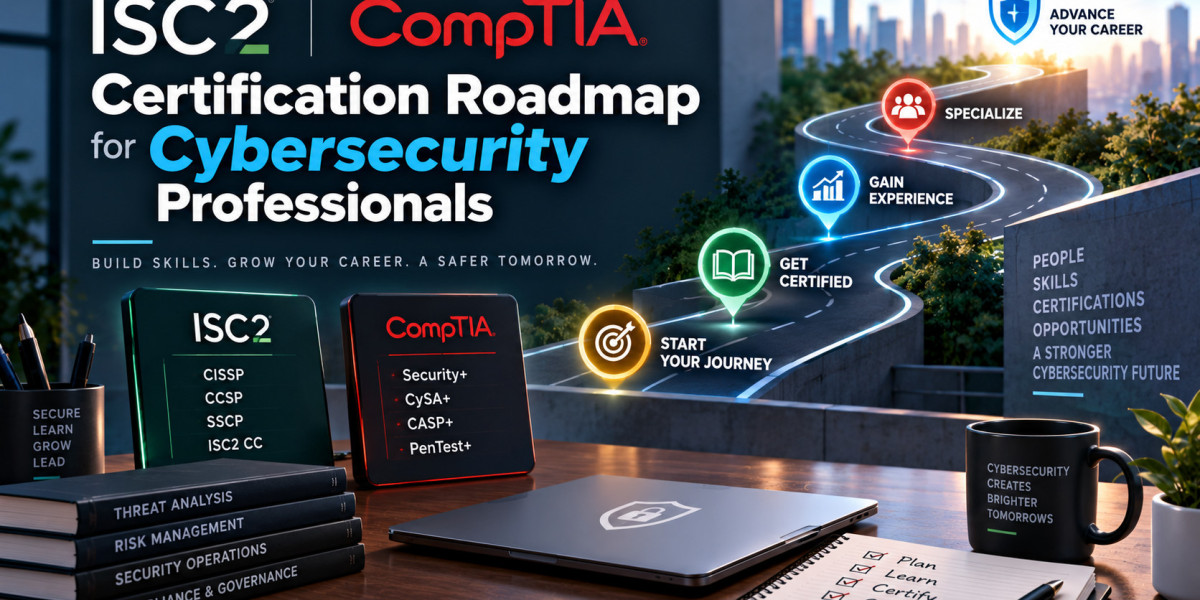

Cybersecurity has developed into a broad career field covering security operations, penetration testing, cloud security, governance, incident response, architecture, and security leadership. For professionals trying to build a long-term career, certifications from ISC2 and CompTIA can provide a structured way to develop and validate relevant knowledge.
The important part is choosing certifications in a logical order. Beginners usually need foundational security knowledge before moving into specialized technical areas, while experienced professionals may benefit more from credentials focused on architecture, cloud security, or leadership.
This ISC2 and CompTIA certification roadmap explains how professionals can progress from foundational cybersecurity concepts to intermediate technical skills and advanced security responsibilities.
Why Combine ISC2 and CompTIA Certifications?
ISC2 and CompTIA both offer vendor-neutral cybersecurity certifications, but their certification portfolios can serve different stages and career objectives.
CompTIA certifications are commonly associated with practical IT and cybersecurity foundations. A learner can progress from basic networking and security concepts toward security analytics, penetration testing, and advanced enterprise security.
ISC2 also provides credentials across different experience levels. For example, Certified in Cybersecurity (CC) requires no work experience, while SSCP is positioned toward hands-on security practitioners. CISSP and CCSP are designed for more experienced professionals and have work-experience requirements.
Instead of viewing the two organizations as competing certification paths, professionals can combine credentials according to their existing experience and intended cybersecurity role.
Stage 1: Build Your IT Foundation
Someone entering cybersecurity without an IT background should first understand the technologies that security professionals protect.
Important foundational areas include:
Computer hardware and operating systems
TCP/IP and networking concepts
DNS, DHCP, ports, and protocols
Windows and Linux administration
Cloud computing fundamentals
Authentication and authorization
Basic troubleshooting
Network architecture
A professional who already works in IT support, networking, cloud administration, or systems administration may already possess much of this knowledge.
CompTIA Network+, for example, can be useful as a networking-focused foundation before moving deeper into cybersecurity. Understanding how legitimate network communication works makes it easier to recognize suspicious traffic, configuration weaknesses, and potential attacks.
Stage 2: Start with ISC2 CC or CompTIA Security+
The next stage is establishing a broad cybersecurity foundation.
ISC2 Certified in Cybersecurity (CC)
ISC2 CC is specifically designed for people entering cybersecurity. ISC2 states that no work experience is required. The certification covers areas such as security principles, governance, identity and access management concepts, networking and cloud security concepts, and security operations and incident response.
This makes CC particularly relevant for students, career changers, and professionals beginning their cybersecurity education.
CompTIA Security+
Security+ is another common foundational cybersecurity credential. Preparation typically develops understanding across threats, vulnerabilities, security controls, identity, network security, risk, operations, and incident-related concepts.
Professionals do not necessarily need both CC and Security+. The appropriate starting point depends on existing knowledge and career objectives.
A possible beginner progression is:
IT Fundamentals → Networking Knowledge → ISC2 CC → CompTIA Security+
Someone with established networking and systems knowledge could potentially begin directly with Security+.
Stage 3: Develop Hands-On Security Skills
After learning the fundamentals, cybersecurity professionals should begin developing practical capabilities.
Certification study should be combined with activities such as configuring virtual machines, reviewing logs, using Linux, analyzing network traffic, practicing access-control configuration, investigating alerts, and learning common security tools.
At this point, the roadmap can branch according to career direction.
For security operations and defensive security, professionals may consider credentials such as CompTIA CySA+ or ISC2 SSCP.
SSCP is intended for hands-on practitioners involved in monitoring, administering, and defending systems, and ISC2 lists one year of required work experience for the credential.
These intermediate credentials make more sense when accompanied by practical experience rather than being treated simply as the next exams in a sequence.
Stage 4: Choose a Cybersecurity Specialization
Once you have established general security knowledge, your certification path should increasingly reflect the work you want to perform.
Security Operations and Blue Team
Professionals interested in SOC operations, threat detection, vulnerability management, and incident response can focus on analytical and defensive skills.
A potential path could look like:
Security+ → CySA+ → SSCP → CISSP
Alongside certification study, build experience with SIEM platforms, endpoint security, log analysis, network monitoring, threat intelligence, and incident-response procedures.
Penetration Testing
Professionals interested in offensive security can move from Security+ toward CompTIA PenTest+ and practical penetration-testing training.
Important supporting skills include Linux, Python or scripting, reconnaissance, web security, vulnerability assessment, privilege escalation concepts, and report writing.
A certification alone is not enough for offensive security. Hands-on labs are particularly important because penetration testing requires applying techniques rather than simply recognizing terminology.
Cloud Security
Cloud security is another strong specialization for professionals already working with AWS, Microsoft Azure, Google Cloud, DevOps, or infrastructure.
After establishing security fundamentals, professionals can develop cloud administration and architecture experience before targeting an advanced credential such as ISC2 CCSP.
ISC2 describes CCSP as an advanced cloud security certification covering cloud architecture and design, data security, platform and infrastructure security, application security, security operations, and legal, risk, and compliance considerations. ISC2 also specifies relevant professional experience requirements for the credential.
A possible progression is:
Security+ → Cloud Fundamentals → Cloud Security Experience → CCSP
Stage 5: Progress Toward CISSP
CISSP is better viewed as a later-career milestone rather than a beginner certification.
ISC2 positions CISSP toward experienced security practitioners, managers, and executives. Its eight domains cover Security and Risk Management, Asset Security, Security Architecture and Engineering, Communication and Network Security, Identity and Access Management, Security Assessment and Testing, Security Operations, and Software Development Security. ISC2 specifies five years of required work experience, subject to its certification requirements.
Because CISSP covers cybersecurity broadly, professionals preparing for it benefit from experience across several security disciplines.
A progression might therefore look like:
Security Fundamentals → Security Operations → Specialization → Professional Experience → CISSP
The objective is not simply collecting certifications. Each stage should correspond with deeper practical responsibility.
A Practical ISC2 and CompTIA Roadmap
There is no single certification sequence that works for everyone. A practical roadmap can be organized by experience level.
Beginner:
IT fundamentals → Networking fundamentals → ISC2 CC → CompTIA Security+
Security Operations:
Security+ → CySA+ → ISC2 SSCP → CISSP
Offensive Security:
Security+ → PenTest+ → hands-on penetration testing → advanced specialization
Cloud Security:
Security+ → cloud platform knowledge → cloud security experience → ISC2 CCSP
Security Leadership:
Security+ or equivalent foundation → technical/security experience → CISSP → advanced specialization where relevant
ISC2 itself organizes its certification portfolio from foundational and early-career credentials such as CC and SSCP through experienced-professional credentials such as CISSP and CCSP.
How to Prepare for Cybersecurity Certification Exams
Certification preparation should begin with the official exam objectives or exam outline. Use those objectives as a checklist and identify weak areas before spending equal amounts of time on every topic.
A useful study process is:
Review the official exam objectives.
Study one domain at a time.
Create short notes for difficult concepts.
Build hands-on labs whenever possible.
Complete practice questions.
Analyze incorrect answers.
Revisit weak domains.
Take timed practice tests before the exam.
Practice questions are most valuable when they are used diagnostically. Instead of memorizing an answer, determine why one option is correct and why the alternatives are unsuitable.
Professionals looking for additional certification preparation material can also explore Cert Mage, which provides exam preparation resources for candidates studying technology and cybersecurity certifications: https://certmage.com
Skills Matter Alongside Certifications
A strong certification roadmap should always be supported by practical skills.
Cybersecurity professionals should gradually become comfortable with networking, Linux, Windows administration, cloud environments, scripting, vulnerability management, security monitoring, identity management, and incident response.
Building a home lab can help convert theoretical concepts into practical knowledge. Even a small virtual environment can be used to configure permissions, examine network traffic, generate logs, practice system hardening, and investigate security events.
Projects also provide evidence of applied learning. Professionals can document lab exercises, security assessments, scripts, detection rules, or incident-analysis projects in a portfolio.
Final Thoughts
ISC2 and CompTIA certifications can complement each other across different stages of a cybersecurity career. Beginners can establish their foundation through credentials such as ISC2 CC and CompTIA Security+, while professionals moving into operational roles can consider certifications such as CySA+ and SSCP.
As experience develops, the roadmap can branch toward penetration testing, cloud security, security architecture, governance, or leadership. Advanced credentials such as CCSP and CISSP become more relevant when they align with professional experience and job responsibilities.
The most effective roadmap is therefore not about earning every available certification. It is about combining knowledge, certifications, hands-on skills, and professional experience in a sequence that supports your chosen cybersecurity career path.
FAQs
Which certification should a cybersecurity beginner start with?
ISC2 CC is specifically designed as an entry-level certification and does not require work experience. CompTIA Security+ is another widely used option for developing foundational cybersecurity knowledge.
Should I take ISC2 CC before Security+?
It can be useful for complete beginners, but it is not mandatory. Someone who already understands networking, operating systems, and basic security concepts may choose to move directly toward Security+.
Is CISSP suitable for beginners?
CISSP targets experienced cybersecurity professionals and has professional experience requirements. Beginners can first develop foundational knowledge, practical experience, and intermediate security skills before pursuing it.
What certification is useful for cloud security?
ISC2 CCSP is designed around cloud security and covers architecture, data security, infrastructure, applications, operations, and risk and compliance. It is intended for experienced professionals.
Which certification path is suitable for a SOC analyst?
A possible progression is Security+ followed by CySA+ and/or SSCP, combined with hands-on experience in SIEM platforms, log analysis, endpoint monitoring, incident response, and threat detection.
Do cybersecurity certifications guarantee a job?
No. Certifications can validate knowledge and support career development, but employers may also consider experience, technical skills, education, communication ability, projects, and hands-on competence.
Should I collect multiple cybersecurity certifications?
Only when they support a clear objective. Building practical experience between certifications is generally more useful than accumulating credentials without developing the corresponding skills.