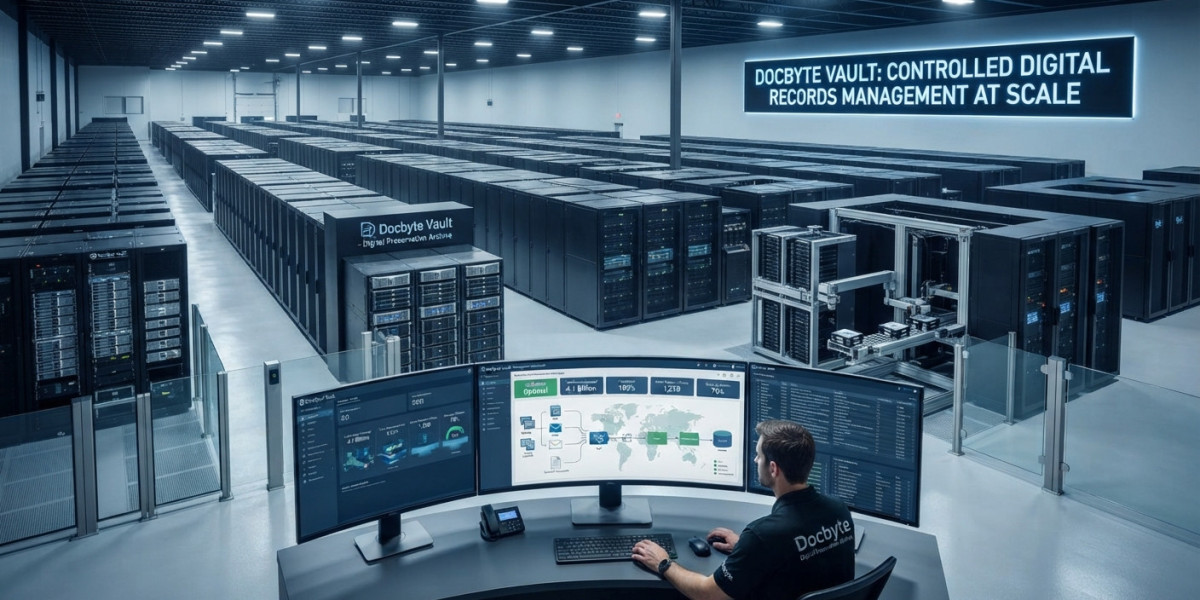

Organizations today manage more digital records than ever before. Contracts, customer documents, financial records, compliance files, signed agreements, employee information, and operational documents continue to grow across multiple systems and departments. While storing large volumes of information is relatively easy, maintaining control over those records throughout their lifecycle is far more challenging. Businesses need to ensure that records remain authentic, accessible, secure, searchable, and properly governed years after they are created.
Docbyte Vault supports controlled digital records management at scale by providing a structured environment where organizations can preserve, manage, and govern records beyond simple storage. It helps businesses maintain record context, integrity, retention requirements, access controls, and long-term availability while reducing dependency on outdated applications and disconnected repositories.
Digital Records Management Becomes Harder as Organizations Grow
Managing a small number of documents is relatively simple. Teams can organize files manually, maintain folder structures, and rely on employees to understand where information belongs.
That approach quickly breaks down as organizations scale.
Large enterprises often manage millions of records across different business units, applications, and storage environments. Information may exist inside ERP systems, CRM platforms, document management systems, email archives, shared drives, cloud repositories, and legacy applications.
This creates several challenges:
inconsistent record classification
duplicate information across systems
unclear ownership
missing metadata
outdated access permissions
difficulty locating historical records
inconsistent retention practices
At this scale, records management cannot depend only on manual processes. Organizations need a controlled framework that ensures information remains reliable regardless of where it originated or how old it becomes.
Storage Alone Does Not Provide Records Governance
Many organizations confuse storage with records management.
Storage answers a simple question:
"Where is the file located?"
Records management requires much deeper answers:
What is this record?
Why does it exist?
Who created it?
Who can access it?
How long should it be retained?
Has it remained unchanged?
Can its history be proven?
When should it be disposed of?
A file can remain available for years while losing important context. A contract PDF may still open, but future users may not know which transaction it belongs to, whether it was the final version, or whether it has been modified since creation.
Controlled digital records management focuses on preserving the complete record, not only the file itself.
Docbyte Vault Creates a Controlled Records Environment
Operational systems are designed for active business processes. Employees create, edit, approve, and use information every day.
However, once records reach the end of their active business purpose, their requirements change.
A completed contract may no longer need editing but may need to remain available for legal review. A closed customer case may no longer require daily access but may still need to be retained for regulatory reasons.
Keeping historical records inside operational systems creates unnecessary complexity.
Docbyte Vault provides a dedicated environment where records can continue their lifecycle after active use has ended. Instead of forcing businesses to keep outdated systems running, organizations can move important records into a controlled preservation environment while maintaining the information required for future access and governance.
Metadata Preserves the Meaning Behind Records
Large record collections become difficult to manage when documents lose their surrounding context.
A file name alone rarely provides enough information. A document called "agreement_final.pdf" does not explain:
which customer it belongs to
when it became effective
who approved it
which department owns it
how long it should be retained
whether related records exist
Metadata provides this missing information.
Effective digital records management preserves important metadata such as:
document type
source system
creation date
business owner
customer or transaction identifier
retention category
approval status
record relationships
lifecycle state
Docbyte Vault helps organizations maintain this contextual information so records remain understandable even when the original applications, processes, or employees involved have changed.
Controlled Ingestion Improves Record Quality From the Start
The quality of long-term records depends on the quality of information entering the archive.
If records enter without proper classification, metadata, or validation, those weaknesses remain throughout the entire lifecycle.
Controlled ingestion creates a stronger foundation by ensuring records are captured with the information needed for future management.
This can include:
validating record structure
applying classification rules
capturing required metadata
identifying record categories
maintaining source information
preserving relationships between records
Instead of creating an archive filled with disconnected files, organizations create structured records that are easier to manage and retrieve.
Integrity Controls Help Protect Records Over Time
Digital records often move during their lifecycle.
Organizations migrate systems, replace storage platforms, retire applications, and modernize infrastructure. Each transition creates potential risks.
Information can lose metadata, become corrupted, or lose relationships with related records.
A controlled archive needs mechanisms that help demonstrate record reliability after these changes.
Integrity controls help organizations verify that information remains consistent and protected throughout its lifecycle.
This may involve:
validation processes
integrity checks
controlled migrations
preservation records
documented lifecycle events
The goal is not preventing all changes. Long-term records may require controlled transformations to remain accessible.
The goal is ensuring every change is managed and traceable.
Retention Management Keeps Records Under Control
As organizations grow, retention becomes increasingly difficult.
Different records have different requirements. A financial document may need to be retained for a specific regulatory period. A contract may depend on the end of a business relationship. A customer record may follow privacy-related rules.
Without proper retention management, organizations often face two problems:
Important records are deleted too early.
Unnecessary records are kept forever.
Both create risks.
Docbyte Vault supports controlled retention management by helping organizations apply lifecycle rules to records and manage information according to defined requirements.
Good records management is not about keeping everything permanently. It is about preserving valuable information for the appropriate period and disposing of it responsibly when its purpose ends.
Digital Records Remain Searchable After Systems Change
Historical records often become difficult to locate because organizations rely on old applications or employee knowledge.
A person who worked with a legacy system may know exactly where information exists. Years later, that knowledge may disappear.
A controlled archive needs search capabilities based on business information rather than outdated technology.
Users should be able to find records through meaningful information such as:
customer references
contract numbers
dates
record categories
business processes
transaction identifiers
Docbyte Vault helps organizations maintain discoverability by preserving structured information around records rather than relying only on the original application structure.
Application Retirement Becomes Easier With Independent Records
Many organizations struggle to retire legacy applications because historical records remain trapped inside them.
The application may no longer support daily operations, but removing it feels risky because someone may need information stored inside.
This creates technical debt.
Organizations continue paying for outdated systems, infrastructure, maintenance, and security management simply to preserve access to old information.
A controlled archive changes this approach.
Records with continuing value can be transferred into a dedicated environment where they remain governed and accessible. The old application can then be retired without losing important historical information.
Docbyte Vault supports this separation between records and applications, allowing businesses to preserve information without preserving unnecessary technology.
Digital Signatures Require Long-Term Evidence Protection
Digitally signed records create additional challenges for long-term management.
A signed document may remain readable for many years, but the evidence supporting its validity can weaken over time.
Certificates expire. Signing platforms change. Cryptographic technologies evolve.
Organizations may need to preserve more than the visible document.
Important elements can include:
signature validation information
timestamps
certificate details
integrity evidence
signer information
transaction history
Docbyte Vault supports preservation scenarios where records require long-term trust and verification beyond the lifespan of the original signing environment.
Access Control Protects Sensitive Historical Records
Large archives often contain highly sensitive information.
Historical records may include:
customer information
employee documents
financial records
confidential agreements
intellectual property
regulatory evidence
Access requirements change as records age.
Employees who needed access during active processing may no longer require access years later.
A controlled records environment allows organizations to manage access according to current business needs instead of allowing outdated permissions to remain permanently.
This reduces exposure while ensuring authorized users can still retrieve important information.
Auditability Helps Prove Records Were Managed Correctly
Organizations often need to demonstrate how records were handled.
During audits, investigations, or legal reviews, businesses may need answers to questions such as:
When was the record created?
When was it archived?
Who accessed it?
Was it modified?
Which retention rules applied?
What happened during migration?
Audit information creates transparency across the record lifecycle.
Docbyte Vault supports organizations in maintaining visibility into important record events, helping demonstrate that information has been managed through controlled processes.
Standards Support Long-Term Information Independence
Digital records often need to survive multiple generations of technology.
Organizations replace applications, change vendors, and modernize infrastructure.
A records strategy that depends completely on one platform creates future risk.
Standards-based approaches help organizations maintain records in a way that supports long-term accessibility and interoperability.
Docbyte Vault focuses on long-term preservation principles that help organizations manage records independently from temporary technology choices.
The purpose is not preserving old technology.
The purpose is preserving valuable information.
Automation Is Necessary for Enterprise-Scale Records Management
Managing millions of records manually is unrealistic.
Organizations need automation to maintain consistent governance across large information environments.
Automation can support:
record classification
metadata management
retention enforcement
workflow routing
validation
reporting
monitoring
This allows records teams to focus on governance decisions rather than repetitive administrative tasks.
At enterprise scale, automation becomes essential for maintaining consistency.
Controlled Records Management Improves Business Confidence
Good records management is not only a compliance requirement.
Reliable records help organizations make better decisions.
Historical contracts, customer information, operational data, and business documents can provide valuable insight when they remain accessible and understandable.
Poorly managed records create uncertainty because important information becomes difficult to locate or verify.
A controlled archive turns historical information into a reliable business resource.
Managing Records Across Their Entire Lifecycle
A strong digital records management strategy follows information from creation to final disposition.
This lifecycle includes:
capturing records correctly
preserving metadata
maintaining integrity
controlling access
applying retention rules
supporting retrieval
managing technology changes
disposing of records responsibly
Docbyte Vault supports this lifecycle approach by helping organizations manage records beyond active business operations while maintaining governance and long-term trust.
The focus shifts from storing files to managing information as a valuable organizational asset.
Conclusion
Managing digital records at scale requires more than adding storage capacity. Organizations need a controlled approach that protects information quality, maintains context, supports retention, limits access, and ensures records remain trustworthy over time.
Docbyte Vault helps organizations create a structured digital records environment where information can continue through its lifecycle independently from the systems that created it. By supporting metadata preservation, integrity management, retention controls, long-term accessibility, and governance processes, it helps businesses reduce information risk while maintaining access to valuable records.
As digital information continues to grow, organizations that invest in controlled records management will be better prepared to handle compliance requirements, technology changes, application retirement, and future business needs without losing the knowledge contained in their digital records.