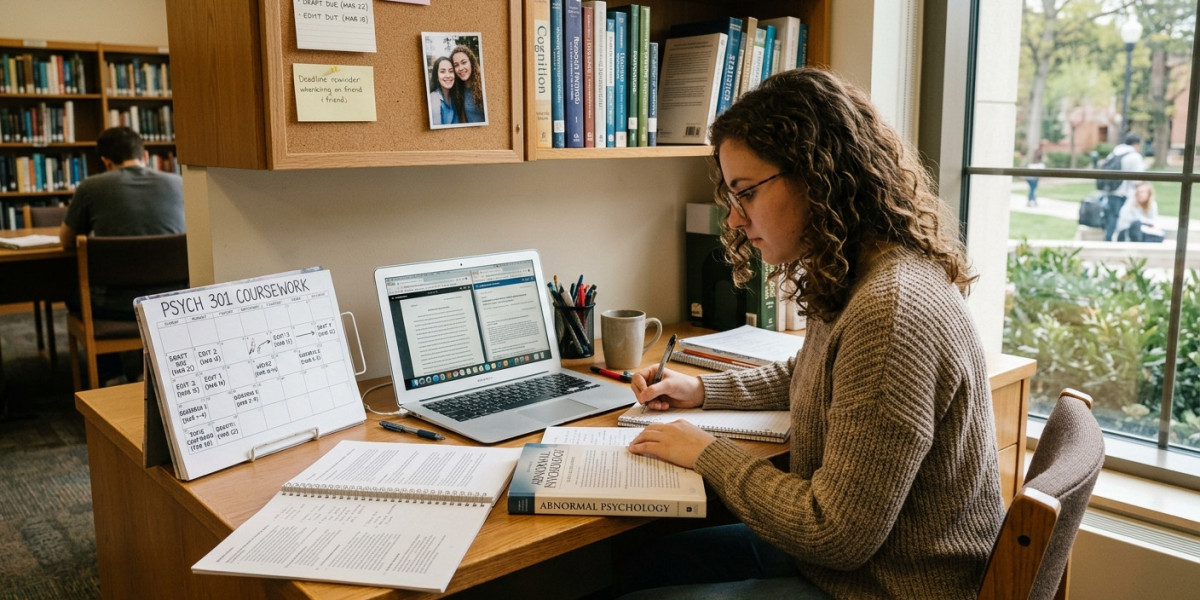

A coursework deadline can look comfortably far away until the research starts taking longer than expected, the question turns out to be more complicated than it first appeared, and your first draft needs another round of work. Suddenly, the final few days are doing far too much heavy lifting.
The answer isn't simply to “start earlier”. What helps more is knowing what needs doing, how long each stage is likely to take, and when each part needs to be finished. Working backwards from the deadline gives you a practical route through the assignment rather than leaving everything to one increasingly stressful final week.
Work Backwards From the Submission Date
Start with the one date you can't move: the submission deadline.
Then work backwards. Instead of putting “finish coursework” into your calendar, give separate deadlines to the stages that lead to it. Depending on the assignment, these might include understanding the brief, researching, planning, drafting, revising, proofreading and checking references.
For example, if your coursework is due on Friday, you might aim to have the main draft finished by Tuesday, the structure and argument reviewed on Wednesday, and the final proofread completed on Thursday. That leaves some breathing room if something takes longer than expected.
The exact timetable will depend on the assignment. A research-heavy essay can't realistically be planned in the same way as a short reflective task. What matters is that every major stage has its own endpoint.
Work Out Where Your Time Is Likely to Go
One of the easiest ways to create an unrealistic schedule is to assume every part of coursework will take roughly the same amount of time.
It won't.
Research can expand once you start following useful references. A question that initially seems straightforward may require you to clarify key concepts before you can build a convincing argument. Editing can also become surprisingly time-consuming, particularly when changing one section forces you to rethink another.
Before setting your timetable, look closely at the brief and ask:
- Which parts require the most research?
- Which terms or instructions in the question need clarification?
- Where will you need to compare, evaluate or interpret evidence?
- Which sections are likely to need more than one draft?
- What other coursework, exams or commitments fall within the same period?
This gives you a much better estimate than simply dividing the available days equally.
Give the Difficult Sections More Breathing Room
It's tempting to begin with the easiest part because finishing something quickly feels productive. The problem is that the difficult section hasn't disappeared. You've simply moved the pressure closer to the deadline.
If one section involves unfamiliar material, complex analysis or extensive evidence, give it more time from the start. You might spend one session breaking down the question, another gathering sources, then separate sessions organising the evidence and developing the argument.
This also helps you spot problems early. If your research isn't producing enough useful evidence, for example, you'll have time to rethink the direction of the assignment rather than discovering the problem while writing the final paragraph.
Your schedule should also match your actual working habits. If you struggle to concentrate after several hours, a series of focused sessions may be more productive than attempting an entire day's work in one sitting.
Break “Finish My Coursework” Into Tasks You Can Actually Do
“Work on my assignment” sounds like a plan, but it isn't specific enough to tell you what to do next.
Break the assignment into actions that have a clear beginning and end. Instead of “research essay”, you might have “find three relevant academic sources”, “read and annotate source one” and “identify evidence for the second section”.
A workable sequence could include:
- Read the assessment brief carefully.
- Break the question into its main issues.
- Identify what each section needs to demonstrate.
- Estimate research time for each issue.
- Gather and organise relevant evidence.
- Create a working outline.
- Draft the sections that require the most thought.
- Complete the remaining sections.
- Review the argument and overall structure.
- Check citations and references.
- Proofread the finished coursework.
- Submit with enough time to deal with technical problems.
Ask yourself:
- Do I know exactly what I need to accomplish in this session?
- Am I researching because I need the evidence, or because I'm avoiding starting the draft?
- Have I given the hardest section enough time?
- What could realistically delay me this week?
Small, visible tasks make it much easier to recognise when you're falling behind.
Don't Treat the First Complete Draft as the Finished Work
Getting the final sentence onto the page can feel like the assignment is over. Usually, it's not.
A first draft may contain repeated points, awkward transitions, unsupported claims or sections that don't fully answer the question. You might also discover that one paragraph has far more evidence than another, or that your introduction promises an argument the body doesn't quite deliver.
Give yourself a gap between drafting and editing if you can. Coming back with fresh eyes makes structural problems easier to notice.
Don't try to fix everything simultaneously. A useful order is:
- Argument: Does the coursework actually answer the question?
- Evidence: Are your claims supported by relevant material?
- Structure: Does each section contribute to the overall argument?
- Clarity: Are the points explained clearly rather than simply stated?
- Presentation: Are grammar, spelling, formatting and references correct?
This is one reason leaving the final evening for “a quick proofread” is risky. By then, you may discover problems that need much more than a spelling check.
Expect Your Timetable to Change
Even a sensible plan can go wrong.
A source may turn out to be unsuitable. Research might take an extra day. Another assignment could suddenly demand attention. You might realise halfway through drafting that your original interpretation of the question doesn't work.
The useful response isn't to abandon the timetable. Rework it.
If research takes longer than expected, look at the remaining tasks and decide what genuinely needs its original amount of time. Perhaps one research session can be shortened, while the editing period should remain protected.
A mid-point review is particularly useful. Ask where you expected to be by now and where you actually are. If you're two days behind with a week still available, there's time to adjust. If you discover the same problem the night before submission, your choices become much narrower.
For students who search for an Affordable coursework writng service when deadlines become difficult, the same principle applies: outside assistance doesn't remove the need to understand the assignment requirements, assess the material and check that the final work meets the brief. The deadline still needs to allow time for your own academic judgement and any necessary changes.
Protect Time for the Final Check
The final checking stage shouldn't be whatever time happens to remain after everything else is finished.
A better plan works backwards from the deadline, gives demanding tasks extra space and deliberately protects time for revision and checking. Even a few hours can make a difference if they're genuinely available for reviewing the finished work rather than completing unfinished sections.
The bigger lesson is that last-minute coursework rarely begins on the night before submission. It usually starts earlier, when research, planning, drafting and editing are treated as one large task with one distant deadline.
Turn that large task into smaller decisions. Give the difficult work room to expand, review your progress before you're in trouble, and finish the main draft before the final day whenever possible.
The deadline then stops being the moment everything has to happen and becomes what it should have been all along: the final point in a process you've already worked through.